How I work
Do not just think about it. Notice what is actually happening.
For me, mindfulness is neither a fashionable add-on nor simply a relaxation technique. It helps us recognise inner states, automatic patterns and their effect on perception, behaviour and decisions more precisely.
Mindfulness-based and systemic
Thinking remains important. It just does not remain alone.
In coaching, we naturally work with language, thoughts and rational reflection. At the same time, emotions, bodily sensations, intuition, movement and spatial experience can make information accessible that has remained hidden in previous thinking.
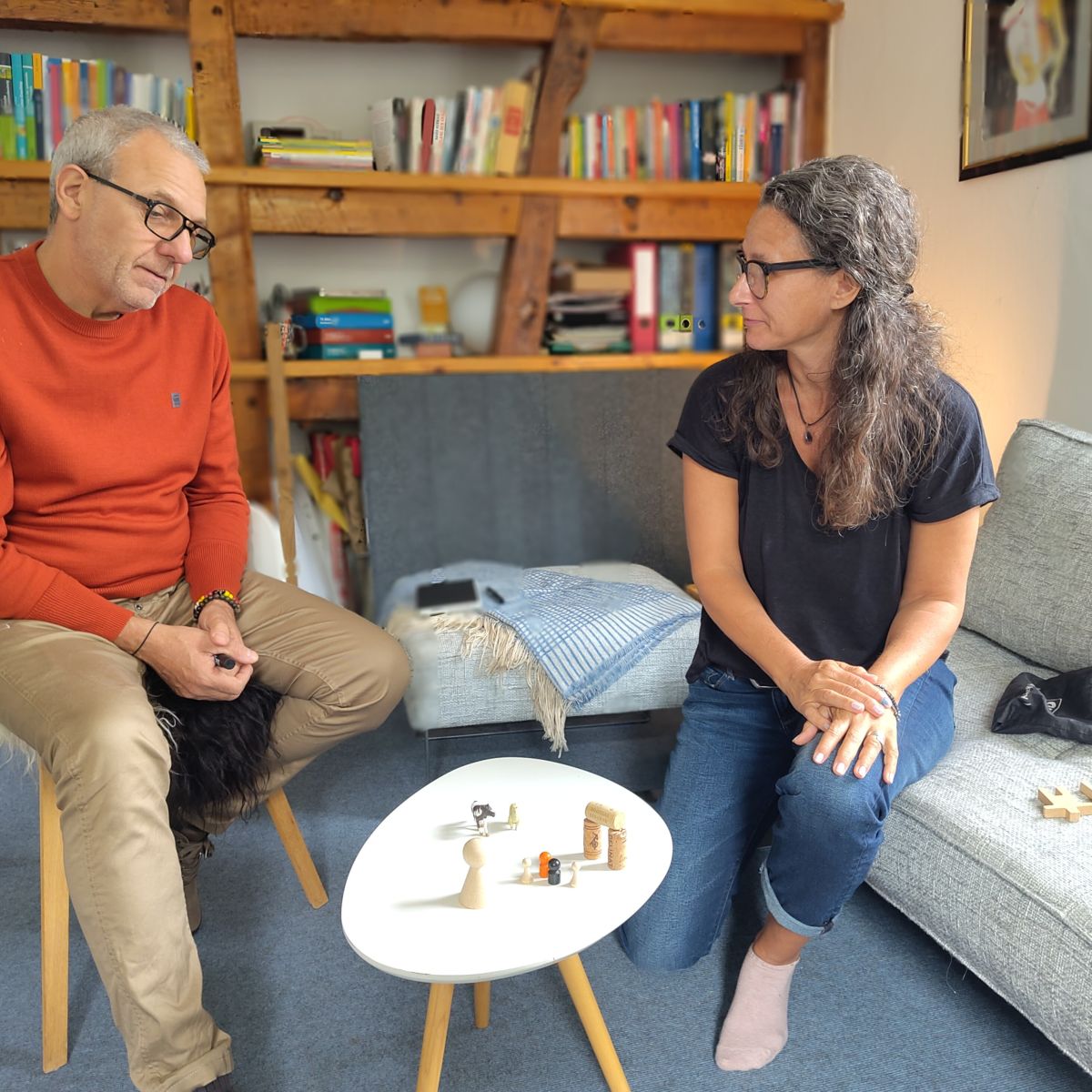
Depending on the person and the issue, we may work through conversation, images, objects, natural materials, inner imagery or positions in space. Not every method suits every person. The method follows the person and their concern – not the other way round.
An anonymised case story
Six solutions – and no decision
Starting point:
A professional musician was experiencing acute strain. At least six possible paths were known. Yet a decision remained unresolved for a considerable time.
We laid out the issue and the six possibilities spatially using picture cards, texts, natural materials and objects. In a later session, the client physically stood on one of the solutions. The other possibilities were covered.
From this position, he looked at his life two years after the assumed decision. When we brought in an important aspect of his life, he spontaneously stepped off the position. He described intense pressure on his shoulders and the feeling that he could not breathe.
The physical reaction did not make the decision for him. It did, however, provide information that had not been accessible through rational weighing alone: this apparently sensible option did not feel right to him.
At the outset, I had also openly addressed the possibility that coaching might reach its limits if the strain developed towards a mental health condition. We agreed on clear mutual feedback and a willingness to choose a different professional setting if necessary.
I do not prescribe a solution. I create a setting in which a person can perceive their own.
A framework for orientation
From what is here right now towards a next direction of your own.
A coaching process is not freestyle. It follows a clear structure while remaining open to what emerges along the way.
I would like to outline one possible process around resilience as one of several examples. It is neither a fixed programme nor a checklist. It helps keep the different levels of an issue in view.
- Notice what is here right now – including resistance, despair or helplessness.
- Distinguish between what can be influenced and what may need to be accepted.
- Reconnect with confidence, resources and strengths from the past.
- Recognise your own possibilities for action and self-efficacy.
- Look at relationships, bonds and your personal network.
- Develop a possible future and reflect on your own path.
Roles in the process
You remain the expert on your own life.
I listen, ask questions, make connections visible and develop appropriate invitations to notice and experiment.
My responsibility lies in the setting, in professional clarity and in addressing overload or boundaries. The meaning of an experience and the decision about your own path remain with you.
Personal contact
Perhaps an outside perspective could help.
Call me or send me an email. In an initial conversation, we clarify what is on your mind and whether the way I work fits your situation.